
Rockhampton Regional Council (RRC) governs a vast Central Queensland region spanning Rockhampton, Gracemere, Mount Morgan and surrounding rural communities. The region is feeling the pressures of climate‑driven hazards, such as floods, fires, cyclones, drought and prolonged heatwaves, all intensified by social and economic vulnerability in the region.
Community attitudes towards climate adaptation are often influenced by regional identity, economic history and misinformation, while traditional climate communication methods, such as scientific reports, warnings and policy statements can be overwhelming, polarising or inaccessible for people. This made it difficult for RRC to engage community members in meaningful conversations surrounding climate change, despite having a climate-resilient strategic focus.
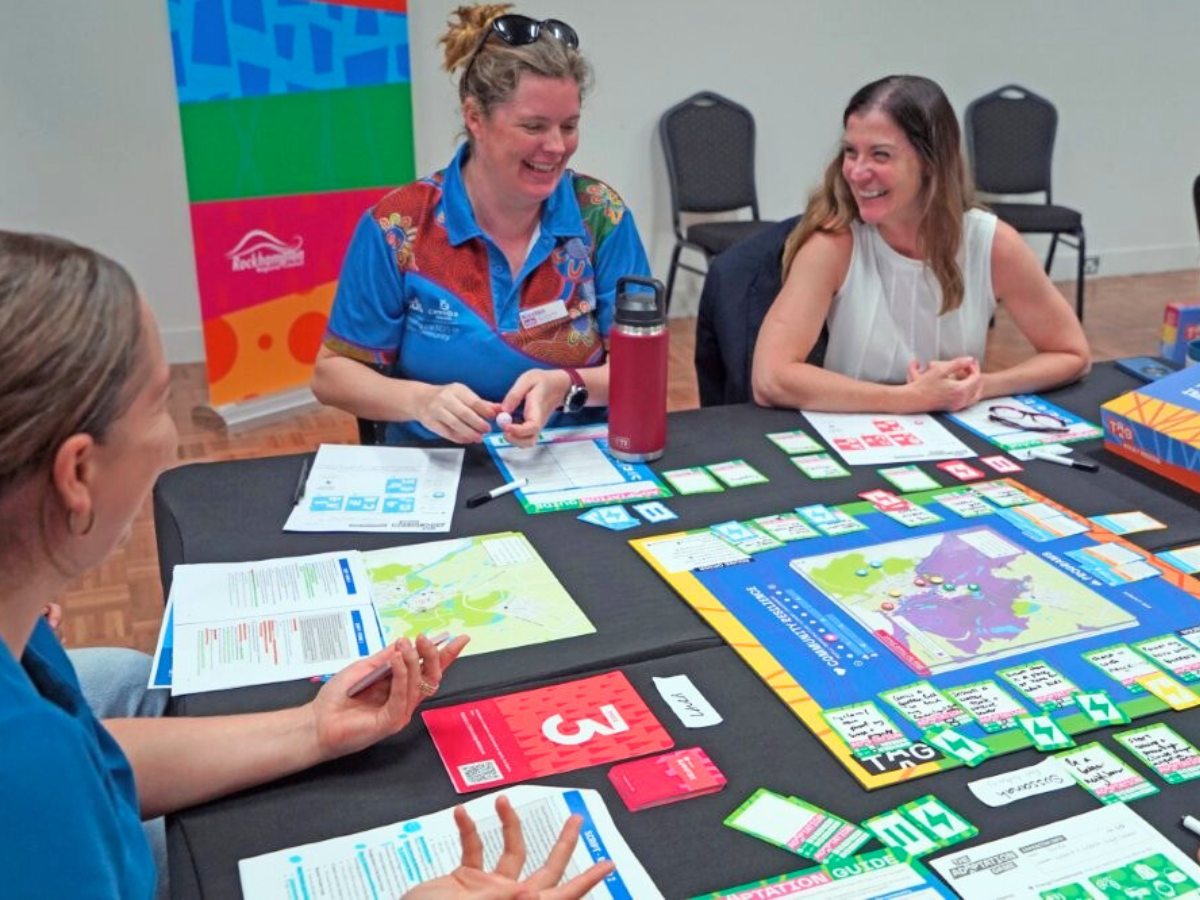
With a $20,000 Community Led Climate Solutions Grant, funded by Hand Heart Pocket, RRC rolled out the ‘TAG Rockhampton Region’ project. The Adaptation Game (TAG) is a playful workshop that enables communities to simulate how they will respond to the next 10 years of climate change. The grant funding, along with additional monetary and in-kind support from Council, was used to deliver facilitator training on the effective use of TAG, as well as the delivery of five community workshops where residents participated in the game.
The TAG approach supports connection in a non-competitive, story-driven manner and helps participants imagine and play out climate risk scenarios grounded in their own surroundings. RRC hoped that by investing in this innovative approach, they would be able to engage with a wide section of their community and use the workshops as an opportunity to raise climate literacy, in addition to consulting and collaborating with a variety of community groups.
During project delivery, RRC collaborated with the community to develop location-specific ‘TAG: Rocky Region’ kits with the aim of sparking climate conversations, building local knowledge and strengthening resilience on an ongoing basis.
There is now improved climate awareness, both in understanding local hazards and adaptation pathways, and increased community agency, with a shift away from feeling that climate change is an overwhelming global issue, to focussing on manageable local solutions that help address climate change.
Attending the workshops has enabled community members to connect with others across different sectors, reinforcing that the whole Council region (which encompasses a 6,500 km2 area) has a shared purpose of addressing adverse effects of climate change on their region. Meeting with participants from across the region has also provided RRC with valuable insights that will shape the future direction of Council’s climate strategy and has stimulated community engagement amongst members on this issue.